
How to pick your next app idea: the 10 → 3 → 1 funnel
Collect ten app ideas, make them fight through elimination rounds, and ship the one survivor – a complete system for choosing what to build next.

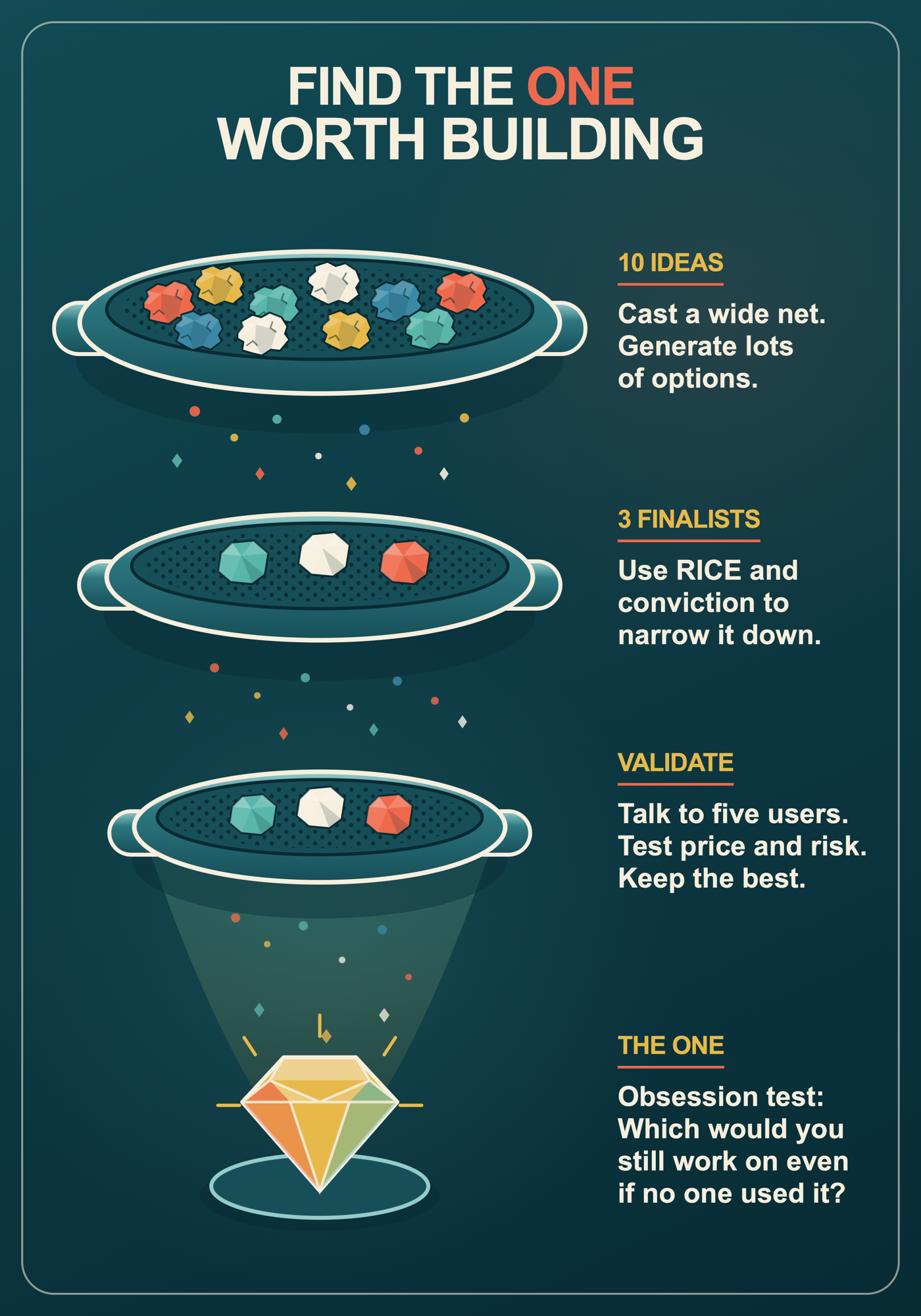
Don’t sit around waiting for one great idea to fall into your lap. Instead, collect ten ideas, then make them fight until only one survives.
In a presentation at SXSW, Michael Lopp – then a senior engineering manager at Apple – described a useful Apple design practice: create ten different mockups of a feature, consider three, then finally land on one. That kind of tight constraint forces you past the first plausible answer you jumped to, and gives you actual alternatives you can compare.
That’s Apple’s system, and it works just as well for choosing your next app: 10 ideas, cut to 3, cut to 1.
The rest of this post is how to run each stage properly – where the ten come from, how to develop them fairly, and the exact elimination rounds that get you down to the one app you’ll actually ship.
Here’s the route:
- Find your ten ideas: the five hunting grounds
- Consider them before you judge them
- Hunt for the drawbacks
- Write ten elevator pitches
- The elimination rounds: 10 to 3
- The Obsession Test: 3 to 1
- Name it, frame it, claim it
Find your ten ideas: the five hunting grounds
Starting with ten app ideas might seem like a lot, but it matters: if you start rejecting ideas early, you’ll be empty-handed once the elimination rounds start doing their job. So, start with quantity first, and apply your judgement later.
There are five reliable places to hunt for app ideas:
1. Scratch your own itch. The best-selling app I ever made serves an incredibly small niche: it’s an app for Latin and Greek students who want to study classical works on their phone. I built it because I was commuting every day and wanted it myself because I studied Latin and Greek at university. It’s a niche within a niche, I know, but as they say, the riches are in the niches.
So, if you hit an annoyance when you’re just going around being you, ask “can that be an app?” What do you hate doing manually? What weird hacks have you invented – sticky notes on the fridge, emailing things to yourself, over-sized Apple Notes documents?
This is how Charlie Chapman – host of the Launched podcast, and creator of Dark Noise and Framous – ended up shipping Overviewer. Here’s how he described it to me:
My wife was a kindergarten teacher when COVID-19 broke out, and we were trying to figure out how to make it easier for her to share a top-down view of her writing letters to kids over Zoom. This naturally spiraled into a hacky iPhone app, then based on her feedback a nicer app, and eventually I figured I should release it to everyone just in case other teachers out there might find it useful.
2. Observe other people’s pain points. Right now, people around the world are leaving 1-star reviews that describe exact problems and wishes. Of course, a review proves that one person felt enough pain to write it down, but it does not prove the complaint is common, that the reviewer is your target customer, or that anyone will pay for your answer. So, look for repeated patterns, then interview the people who have the problem.
 Tap for full-size (opens in a new tab)
3. Piggyback trends. Behavioral trends such as journaling for mental health, digital detoxing, sleep tracking, or micro-learning all happen constantly, which makes the bestsellers in the Self Help aisle of your local bookstore are a free idea list. Technology trends are rarer but bigger, because they force everyone back to square one. Right now that shift is obviously AI, but “just add AI” isn’t a plan by itself.
So, start with a real job a model improves, check the availability of Foundation Models and its device requirements, and design the useful fallback for when the model is unavailable. It’s so important that on-device inference protects privacy and avoids per-request API charges, but please remember that QA, support, and platform availability still exist.
4. Build on APIs. So many important iOS apps aren’t much more than network requests and lists of data – Facebook, Instagram, Audible, even Apple’s Mail and Podcasts. So look for APIs: travel with Skyscanner or Amadeus, events with Ticketmaster or Eventbrite, food with Spoonacular or Edamam. Better still, combine two APIs at the same time: a news API plus text-to-speech makes custom morning news podcasts, or Apple Music plus HealthKit makes bedtime playlists tuned to your sleep history, etc.
5. Pick off the weakest. Go through the most popular apps in a category and look for poor execution you could beat. A word of caution, though: just being better is sometimes not enough. Remember Google+? Google spent an astonishing amount of money building a better Facebook – and by pure features, arguably did – but nobody would give up their friends to move.
Instead, name your specific switching reason – maybe importing existing data takes one tap, a recurring five-minute job becomes automatic, or a specialist workflow works offline. Now put that claim in front of current users of the alternative and see whether it’s enough to make them move.
And if you’re still somehow stuck, I made a small website called MakeThis.app that shows you a random app idea – name, tagline, features, target user, monetization strategy – every time you refresh. Some ideas are great, some are complete nonstarters, but even a bad one might start you off in the right direction.
So, here’s your first bit of homework: write down 10 ideas now, before reading on. No cheating.
Consider them before you judge them
Some great ideas sound unhinged if you judge them too early:
- “I’m going to build a website where anyone can upload cat videos and 3-hour Minecraft walkthroughs, and it’ll become the new TV.”
- “I’m going to build a platform where people post 140-character thoughts, often while on the toilet, and eventually a US President will use it to make nuclear threats.”
- “We’ll take the existing idea of sharing photos, but restrict it to square images with filters that make everything look like 1975. Millions will join!”
Yes, that’s YouTube, Twitter, and Instagram. Sorry not sorry.
So before any cutting happens, make sure every idea gets room to breathe. For each of your ten, just start writing down as many things as you can about the app – no filters, no limits, no worrying about what’s possible in your timeframe. We’ll nail things down soon; for now, fantasyland is the assignment.
If blank-page brainstorming is hard, try flipping it by working problem-first. What exact problem does this solve? Who feels it, and when do they feel it most? What are the current workarounds, and which part of those workarounds sucks?
An AI chat is genuinely useful here too – not to have ideas for you, but as a sparring partner that pushes back on your thinking and really exercises your ideas.
Honestly, half the time I don’t know the vocabulary for what I want until the conversation guides me there, but I definitely know what I don’t want, and that’s what gets us to the destination. It’s the McDonald’s Theory in action – Jon Bell’s observation that suggesting McDonald’s for lunch instantly inspires everyone to produce better ideas. People are inspired to come up with good ideas to ward off bad ones, and an LLM is an endlessly patient supplier of bad ones.
Hunt for the drawbacks
And now it’s time for the painful part: a healthy dose of realism. Go through every feature you listed for every idea, and write down its drawbacks, constraints, and potential problems.
Yes, all of them, even the minor ones:
- “I don’t have a server to run a back-end on.”
- “This needs real content to work, and I don’t have the budget for it.”
- “I think Apple’s App Review team might not like me doing this.”
- “This API costs a lot of money, and I don’t want that risk right now.”
- “This requires authentication, and I just don’t want that pain in my life.”
List even the small ones, because when it comes to the crunch, an idea with 30 minor drawbacks is significantly trickier than one with 3.
Write ten elevator pitches
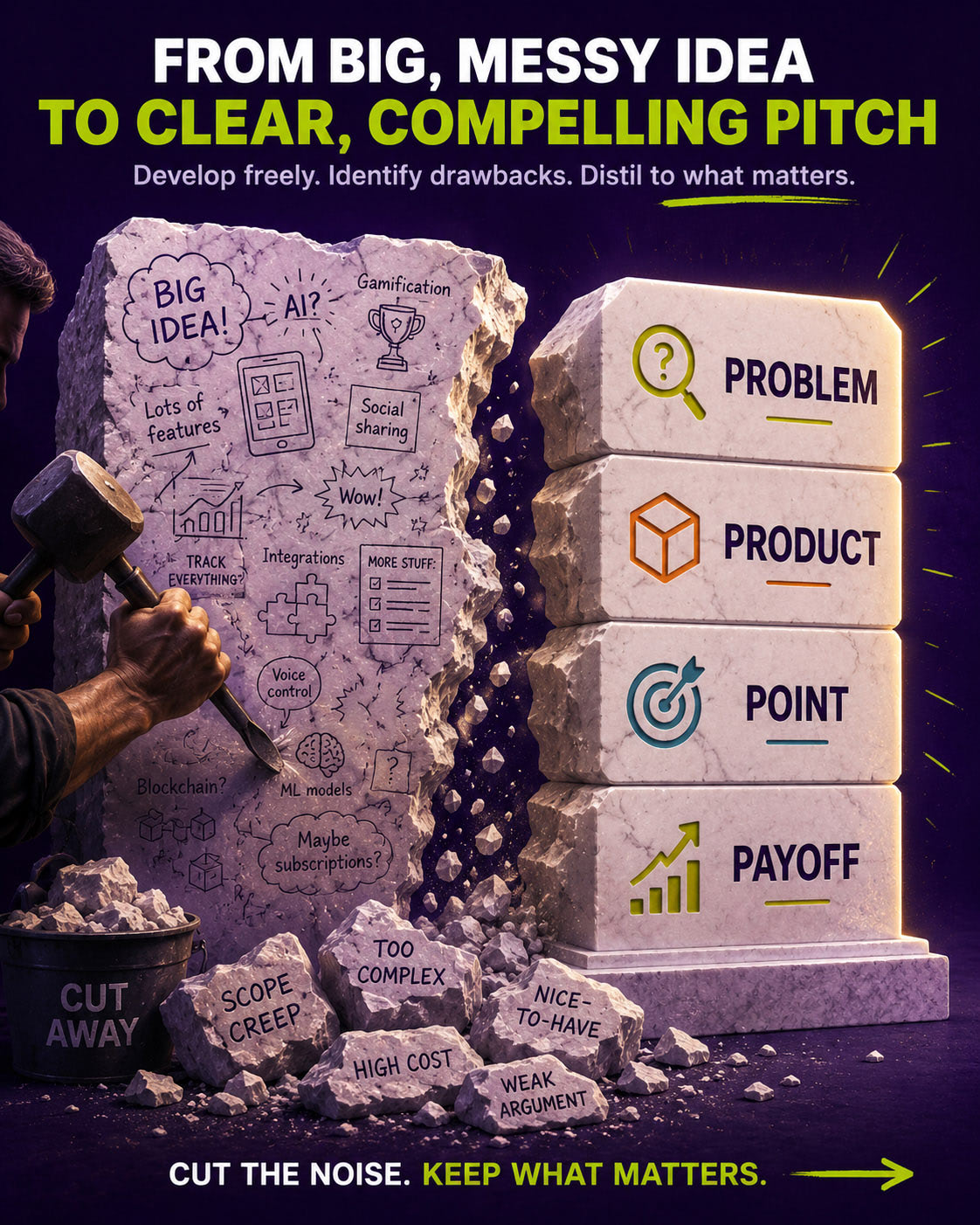
Next, boil each idea down until you could explain it in an elevator ride. I spent part of 2013 on a UK trade mission around Silicon Valley, delivering the same elevator pitch dozens of times – and refining it pretty much every time. Since then I’ve stuck with one formula: problem, product, point, payoff.
 Tap for full-size (opens in a new tab)
Here it is using a practical example:
- Problem: “Children find it hard to learn foreign languages.”
- Product: “LingoKid is a language learning app aimed specifically at children aged 3–11.”
- Point “We use gamification to make language learning fun.”
- Payoff: “Your kids will stay curious and learn to love languages.”
That’s one short sentence for each of the Ps, for each of your ten apps. This step matters more than it looks, because if you can’t boil an idea down to a simple pitch it’s just not going to work.
Say it with me: if you’re explaining, you’re losing.
The elimination rounds: 10 to 3
At this point you have ten ideas that have been carefully considered, each of which could potentially work. But unless you have a startlingly low quality bar, trying to ship all ten is a bad idea, so it’s time to make your ideas fight.
This takes five rounds in total, each cutting the list from a different angle.
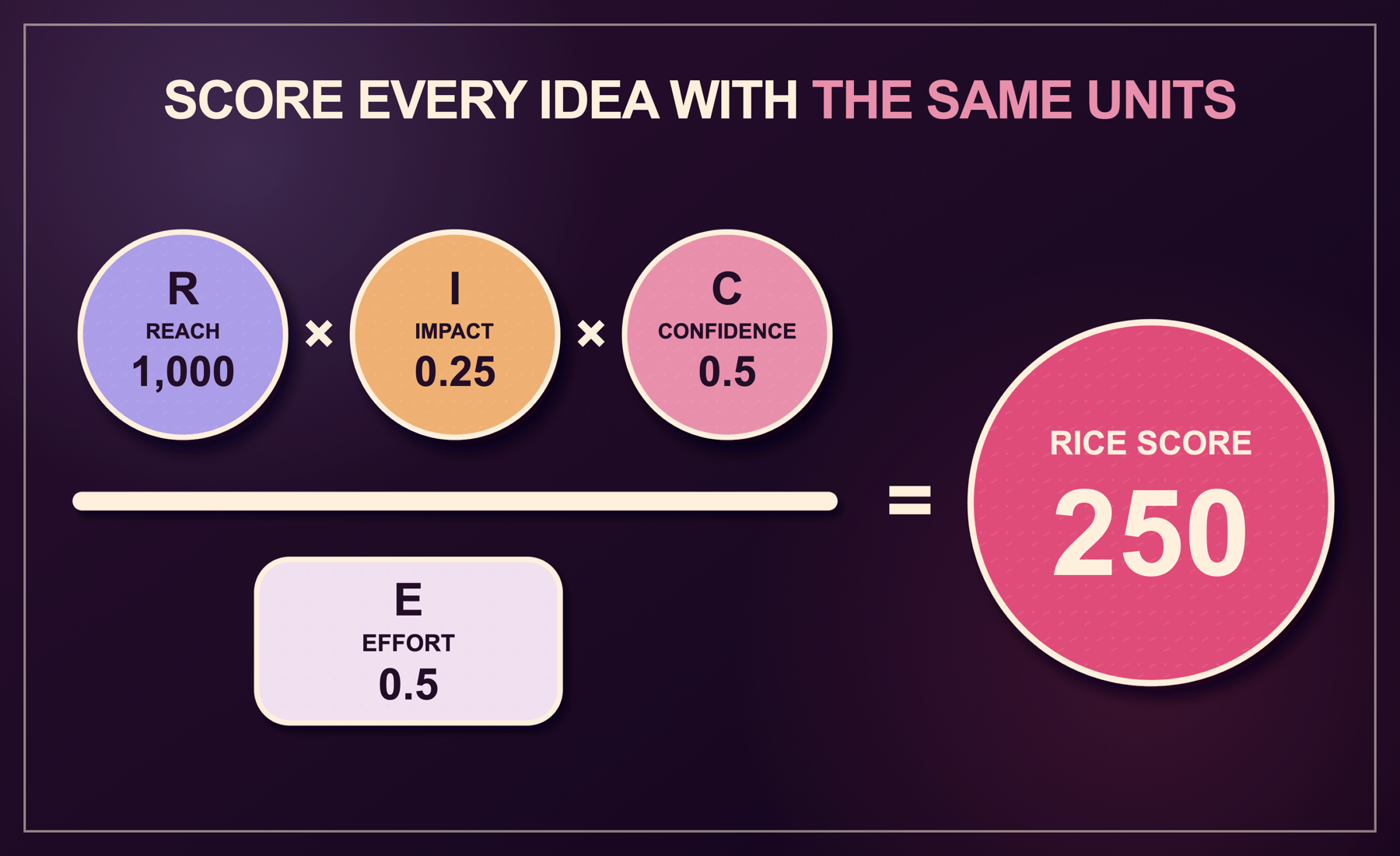
Round 1: RICE – cut three. Use the RICE model consistently: estimate Reach as people affected in a defined period, Impact on its 0.25/0.5/1/2/3 scale, Confidence as 50%, 80%, or 100%, and Effort in person-months. Then calculate Reach × Impact × Confidence ÷ Effort.
Let’s work through a practical example: an app that reminds you the night before your rubbish gets collected. Suppose you estimate 1,000 reachable customers in the first year, minimal impact at 0.25, low confidence at 50%, and half a person-month of effort. That’s 1,000 × 0.25 × 0.5 ÷ 0.5, which gives a RICE score of 250.
For new apps, reach and impact are usually guesses, which makes RICE more of a conversation aid than market evidence. Score all ten of your app ideas with the same units, order them, and cut the bottom three. Don’t delete them, because you might want them later. Instead, just move them to a “not right now” list with the assumptions that held them back.
Round 2: Clarity and conviction – cut one. Great products are packages of emphasis: some things done brilliantly, some deliberately left out. Which of your ideas screams a clear, opinionated point of view, and which feels like it would end up 5/10 at everything and 10/10 at nothing? Cut the weakest. (Yes, even if it has the highest RICE score.)
Round 3: Impact over reach – cut one. If two ideas score similarly, keep the higher-impact one regardless of reach. It’s a personal choice, but I would much rather have a few thousand people who adored my product than 100,000 who sort of kind of maybe liked it – passionate users convert to paying customers more easily, stay longer, and recommend you to others. Reach is a scale problem you can buy later with marketing, but love isn’t. Cut the lowest-impact idea.
Round 4: Would you use it? – cut one. You’ll have stronger opinions, better maintenance instincts, and – mainly – a far higher chance of actually finishing if you’re building something you want yourself. Cut the one you’re least likely to use.
Round 5: Which makes the most money? – cut one. There’s no shame in picking projects on revenue potential. Tools such as Sensor Tower try to estimate competitor downloads and revenue, but it’s risky to use those as proof. Low estimated revenue might mean weak execution, weak demand, or simply a bad estimate. Use something like the coffee test as a starting point, then test price and willingness to pay with target customers.
Here’s how Adam Lyttle described his filter to me:
Initially I would build every idea I thought of – I would build an app, release it on the App Store, and then just hope for the best. No marketing or advertising. Just sink or swim. As it turns out, the apps that did well were the ones people were searching for. Now, instead of building every single idea I simply put it through a filter: ‘will people download this app, and how much competition is there?’
Hands up if you’ve taken the sink-or-swim approach before. Everyone has – me very much included. We love coding so much it’s the first thing we reach for, and I’ve met countless people who would much rather create a new Xcode project than try and do a little marketing for what they already have. (Also, you should follow Adam) – he shares tips every day!)
That’s five rounds in total, and if you’ve followed them you should be down to three strong ideas.
Now give each finalist a one-week validation sprint: interview five target users, put a price on a landing page or manual prototype, test your riskiest assumption, check names and trademarks, and calculate how many paying customers cover the first year. Record what changed your confidence.
The Obsession Test: 3 to 1
The final cut isn’t about RICE scores, revenue, or features. In fact, it isn’t about the app at all. It’s about you: of your three ideas, which one are you personally obsessed with? Which one do you wake up thinking about? Which one has you making voice memos on the walk to the coffee shop? Which one would you still work on if no one was using it?
This matters because building apps is hard, marketing them is harder, and maintaining them is harder still. If you aren’t absolutely on fire for the idea today, you’ll be lucky to have a spark left in six months.
I asked Michael Flarup – designer of Conduct This and of icons for Apollo, Slopes, Working Copy, and more – how he knows an idea is worth committing to:
Once you realize that ideas are just an endless parade of potential love interests, it becomes clear that the real work begins after the first date. Before evaluating whether an idea is worth pursuing I try to imagine, not the end result, but the sort of work I would have to do to develop that idea. If that journey feels like something I would enjoy, then – and only then – do I consider all the other aspects of the idea. The good ideas aren’t the ones where you can envision a successful final product, but the ones you would have fun working on.
Every time I read this it feels like a smack in the face, because it contains the single biggest truth for finding a great app idea: the best idea isn’t the one with the biggest market – it’s the one you’ll actually finish.
Pick the one that pulls you in without even trying. That’s the one. That’s your app.
(And if you’re still stuck staring at two apps, toss a coin – because when that coin is in the air, you’ll know exactly which one you want to win.)
Name it, frame it, claim it
Three quick things lock it in:
- Name it – final name, working title, or cool-sounding code name; naming it matters.
- Frame it – write your name and elevator pitch on one sheet of paper and put it up somewhere you can see it easily.
- Claim it – write your first user stories (“As a __ I want to __ so that __”), and commit out loud: post it on social media if you’re brave, or at least say it to yourself. This is an app you will ship.
From this point forward, you’re not just thinking about building an app – you are building it.
Stop reading, start doing
- Write down 10 app ideas today, using the five hunting grounds above. No judging yet.
- This week, brainstorm each one, list its drawbacks, and write its problem–product–point–payoff pitch.
- Run the five elimination rounds and get to three.
- Apply the Obsession Test, name the winner, and stick the pitch on your wall.
There’s nothing stopping you from starting now, so go and get that first idea list written!