
What kills apps, and why it isn’t being Sherlocked
Apple added Dark Noise’s core job to iOS, and the app still earns over $4,700 a month. Sherlocking is a real risk, but it isn’t an automatic death sentence.

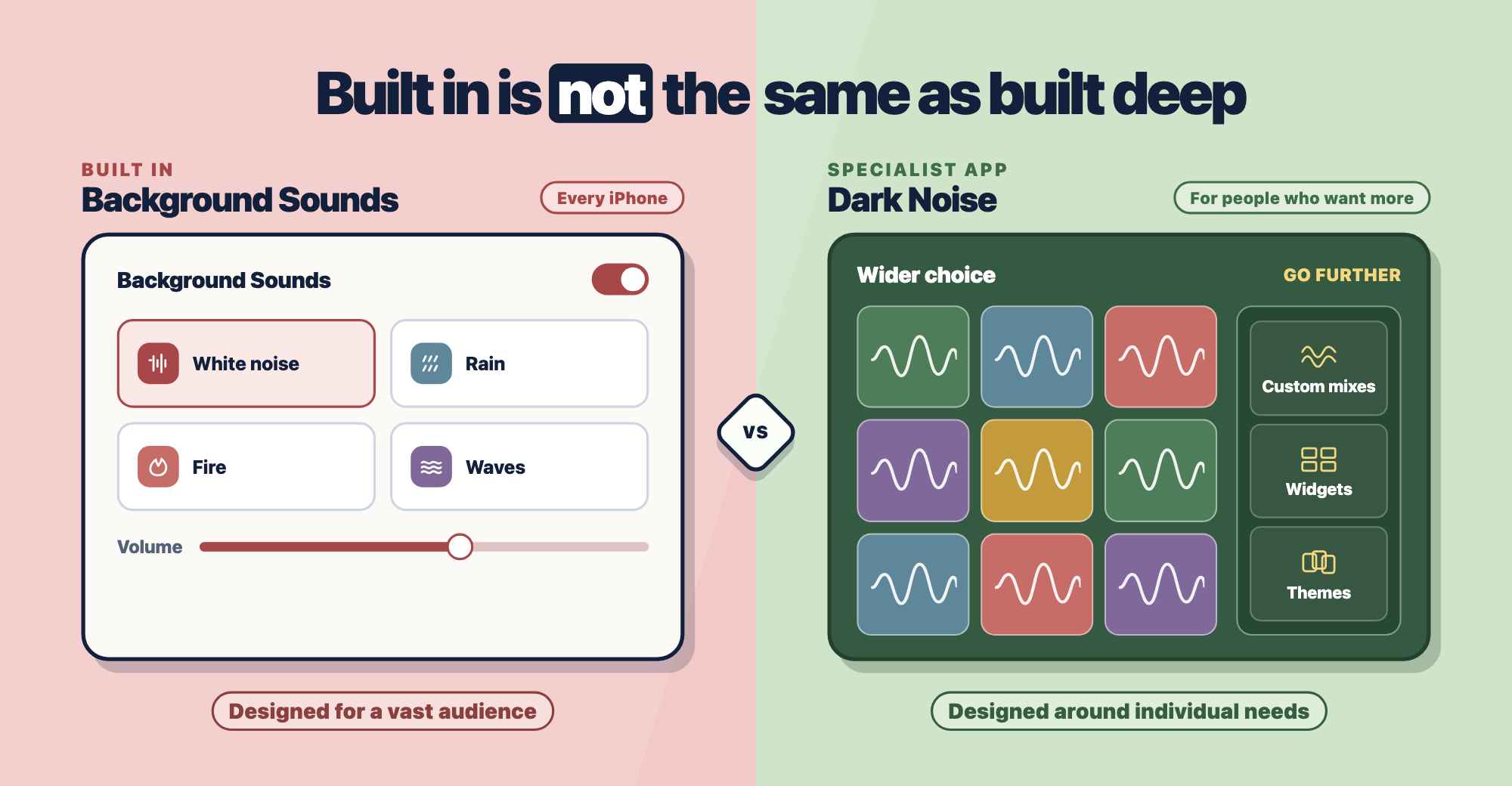
In 2021, Apple shipped a built-in feature addressing the same core job as Charlie Chapman’s app. Dark Noise plays ambient sound to help you sleep and focus – white noise, rain, fire, waves – and iOS 15 shipped with Background Sounds, a system feature that plays… white noise, rain, fire, and waves. Free, and preinstalled on every iPhone on the planet.
Nearly five years later, the app is still going strong. In fact, at the time of writing (July 27th, 2026) Dark Noise’s RevenueCat-verified public page showed $4,731 in monthly recurring revenue and 2,606 active subscriptions, which is one heck of an answer to “what if Apple builds this into iOS?”
And so, one thing is abundantly clear: being Sherlocked is not an automatic death sentence.
If the term is new to you: “Sherlocking” dates back to 2002, when Apple’s Sherlock 3 absorbed the features of a third-party tool called Watson, and developers have feared the ghost ever since. Ask a room of indie developers what keeps them up at night and “what if Apple just builds this into iOS?” is near the top every single time.
Dark Noise, with its classic icon and thousands of subscribers, makes the practical point beautifully: a specialist product can keep earning after Apple addresses the same broad need.
Why the scariest one isn’t
The iPhone is Apple’s largest business, and as such its system features need to serve a vast audience. However, their goal of providing something for everyone leaves “genuinely great for someone” wide open. That leaves room for Halide to obsess over cameras, Fantastical over calendars, and Dark Noise over ambient sound – all apps providing specialist depth Apple does not want (or even need) to ship to every iPhone owner. For Dark Noise, that means more sounds, more control, and more care than a checkbox buried in Settings.
Heck, Background Sounds is still being actively expanded by Apple – iOS 26 added eight more background sounds! But rather than replacing Dark Noise, what happens is quite beautiful: when Apple adds a feature, it teaches millions of customers that the category exists, and Dark Noise continues to offer the deeper specialist version people were willing to pay for.
Now, I’m not going to pretend platform risk is imaginary: building on someone else’s platform means they could ship a serious competitor in the next iOS update – or, worse but hopefully less likely, make an app review guideline change that causes real problems for you. But while that risk is part of the rent we pay in Apple’s developer program, Dark Noise shows the result is not predetermined.
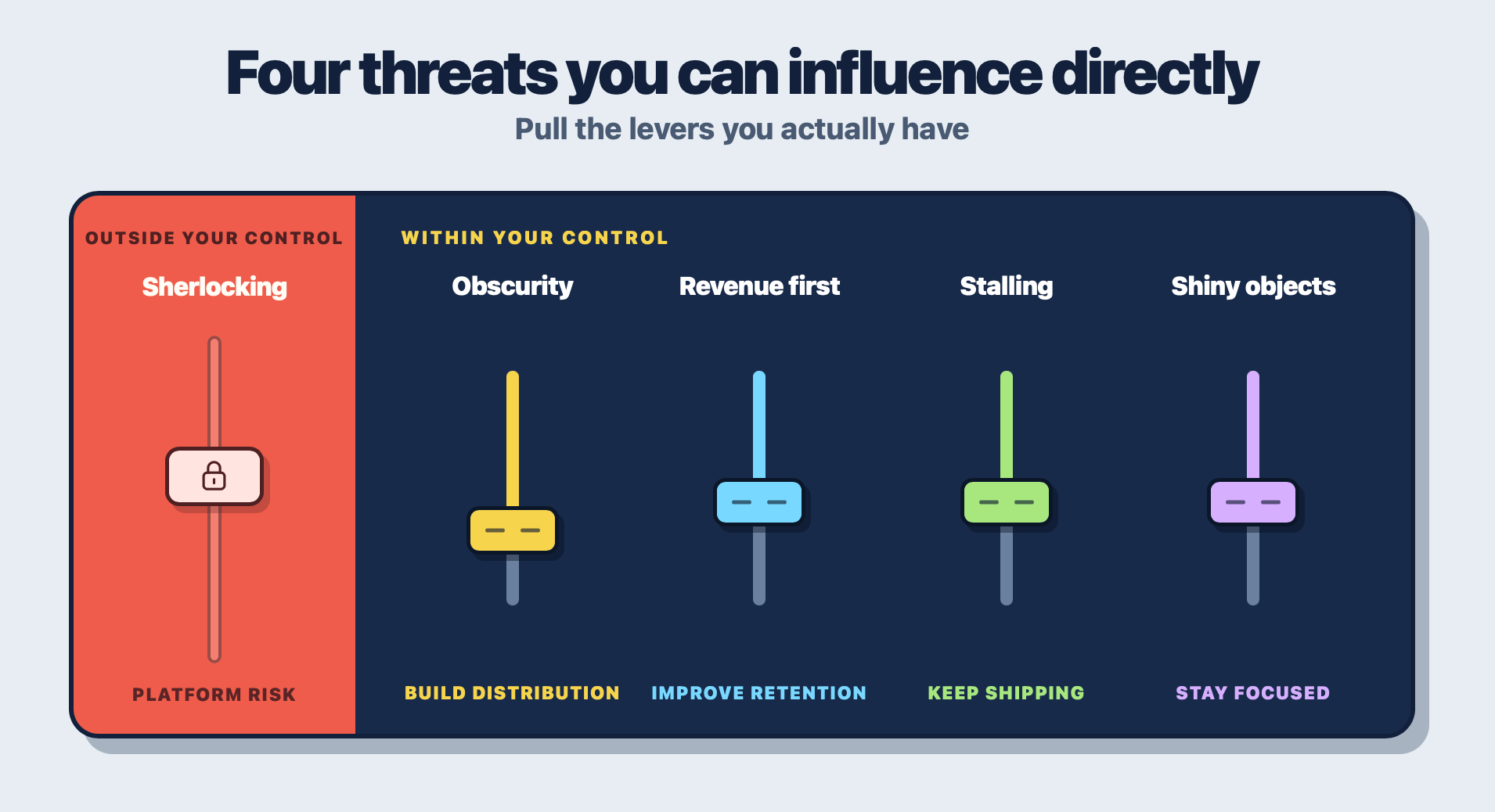
So, let’s look at four threats you can influence directly…
The four things that actually kill apps
Developers worry most about Sherlocking, but obscurity, chasing revenue before retention, stalling, and shiny object syndrome (my own favorite!) are likelier threats.
1. Obscurity
The biggest killer of apps is distribution, and it’s not even close.
Hundreds of apps launch every single day, and by far the biggest bottleneck to success is simply that people don’t know your work exists.
Marketing matters even more than you think it does: you could do marketing every day for a year and still be reaching new people on December 31st. Just think how many billions of dollars Apple spends on advertising every year – we’re talking gigantic billboards in Times Square, for example – all trying to get the word out about their products, and if they aren’t done telling people about the iPhone then you aren’t done telling people about your app.
That obscurity problem is most of the reason I built Kickstart – its launch calendar runs from 45 days before release to 60 days after, precisely because getting noticed is a campaign, not a one-off launch-day event.
2. Chasing revenue instead of retention
A fast way to kill an app is focusing solely on revenue when your first priority should be keeping existing users coming back. Revenue growth matters, but if it’s your only focus you’ll alienate the people who liked your app and lose sight of what made it good in the first place.
I asked Shainiel Deo how he balances revenue against building more great games like Jetpack Joyride and Fruit Ninja. Here’s what he said:
“Halfbrick has stayed relevant for so long because we care about the art of making games. We prioritize making great games over just focusing on the revenue. Don’t get me wrong, we realize that we need to make money from our games in order to stay in business – it’s just not the key consideration in what we do.”
Tim O’Reilly, founder of the O’Reilly publishing empire, summed the whole balance up in one line: “Money is like gasoline during a road trip: you don’t want to run out of gas on your trip, but you’re not doing a tour of gas stations.”
3. Stalling
The third killer is quieter: your iterative improvements stall because you’re running out of ideas for marketing, losing direction with your original idea, or just tinkering rather than shipping.
Let me make this nice and clear for you: if you think you’re running out of ideas for marketing your app, no you’re not.
Try something serious. Try something funny. Try marketing a specific feature. Try piggybacking off a viral trend. Try a “day in the life” video. Try showing your earliest prototype and how far it has come. Try turning a support ticket into a story. Try challenging users to beat you at your own product. That’s eight ideas in one breath – the well isn’t dry, you just need to lower the bucket a bit more.
So here’s your homework: pick three of those you’ve never tried and put them in your calendar. And don’t do it “some day” – put them in this week, so it actually gets done.
Maybe you haven’t noticed, but I’ve been publishing these blog posts on Monday, Wednesday, and Friday every week. I made a big stash of them before release (see here for why that delayed Kickstart’s launch!), but I made a promise to friends that I would actually release them three times a week, for as long as I’m able to keep it going.
The other half of stalling is futzing with what you have instead of getting it out there – maybe second guessing your original idea, maybe nudging pixels around before they’ve even seen a user, or maybe just being a bit scared of pressing the Submit button.
Look, getting your app shipped took a lot of work – don’t shortchange it now by endlessly polishing instead of developing it further.
4. Shiny object syndrome
The final killer: you get bored of the app and wander off, leaving it to succumb to bit rot.
I know how powerful shiny object syndrome is because I feel it myself every single day. The only way I’ve found to beat it is to recognize it exists, and keep your eyes on the reason you built the app in the first place – when you put your purpose before your product, shiny objects start to look like the distractions they really are.
Of course, Apple also provides a stick as well as a carrot: under their App Store Improvements process, an app that has not been updated within three years and has had very few or no downloads in a rolling 12-month period can be flagged for possible removal – a rather sad way for any app to go.
If you’re struggling to avoid all the shiny objects out there (looking at you, iOS 27!), try focusing on the people who already found your app and are sending money your way. Here’s some gold dust from Ariel Michaeli of Appfigures:
“Viral hits chase installs. Sustainable apps chase engagement… Developers who think long-term design their app to be useful on day one and day thirty. They build hooks, not just first impressions, measuring retention and work to improve it because they know a retained user is more valuable than ten bounced installs.”
The killer isn’t in Cupertino
So, we have obscurity, revenue tunnel vision, stalling, and shiny object syndrome. Notice how Apple isn’t in any of them? Instead, every one is self-inflicted, which is bad news for your ego but great news for your app, because every one of them is fixable by you, this week, without waiting for permission from anyone.
You’ve seen how a company worth trillions shipped Charlie Chapman’s app’s core job as a system feature, and thousands of people still pay for his deeper version. Apple can own the broad need, but Charlie’s specialist version wins on depth, retention, maintenance, and distribution.